
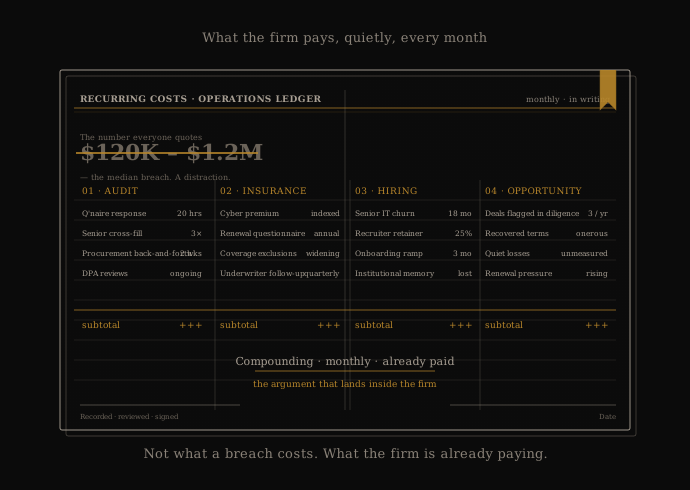
The financial impact of a breach is the easiest thing to measure and the hardest thing to use as an argument internally. Every executive has seen the IBM Cost of a Data Breach report. The median number — $120k to $1.2M for a mid-market firm, depending on whose study you cite — is large enough to be dismissed as unlikely and small enough to be discounted against next year's revenue.
The argument that lands is not the breach cost. It is the cost the firm is already paying — quietly, monthly — to operate with an under-invested security posture.
The audit tax
Every enterprise client your firm wants to work with will, at some point, send a security questionnaire. Without a documented posture, that questionnaire takes a senior person twenty hours to fill out — repeatedly, for each client, with no compounding benefit. A firm that runs assessments against a published framework writes the answers once.
Firms that have done this work report the per-questionnaire cost drops from a week of senior time to a half-day of administrative time. The arithmetic compounds across every enterprise client a firm pursues.
The insurance tax
Cyber insurance premiums are now tightly indexed to documented controls. Underwriters ask the same questions the regulators ask. A firm that cannot produce written incident response procedures, MFA enforcement evidence, and backup verification logs pays a premium that absorbs most of the budget that would have funded those controls in the first place.
The hiring tax
Senior practitioners do not stay at firms that ask them to operate without basic infrastructure. The cost of replacing a competent IT lead — eighteen months of search, three months of onboarding, the institutional memory that walks out the door — exceeds any single year of security spend.
The opportunity tax
The hardest cost to estimate is the engagement that does not happen because procurement flagged a security gap during diligence. Firms rarely learn why they lost the work. We have seen this in three engagements in the last year, two of them recoverable only by accepting onerous remediation terms in the contract.
The defensible position
The argument that wins inside a firm is not "what does a breach cost." It is "what are we paying right now to operate without this in place."
A documented security posture is not an insurance policy. It is operational infrastructure. The firms that have done the work are the ones that can answer the questions an enterprise procurement team will eventually ask — and the ones whose practitioners stay long enough to keep building.