
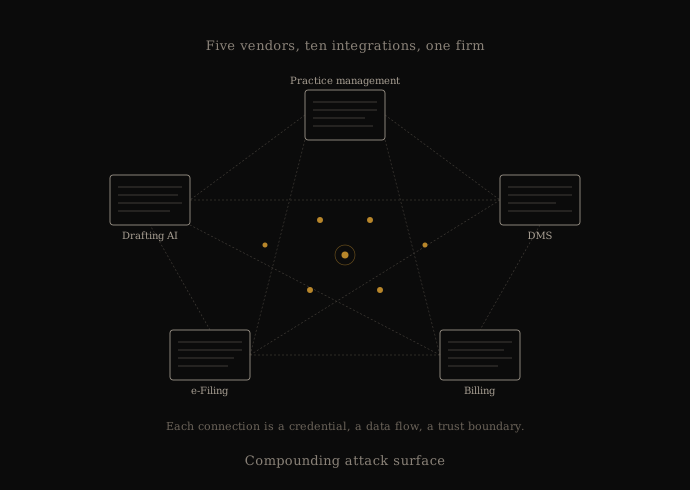
The modern law firm runs on five separate SaaS products. Practice management. Document management. A drafting assistant or two. Time and billing. Court e-filing. Most firms add a sixth for discovery and a seventh for the partner-portal client experience the management committee insisted on last year.
Each of these is sold as a productivity tool. None of them is sold as what it actually is — a permanent third-party copy of the firm's most sensitive work product, sitting on infrastructure the firm does not operate, audited by people the firm has never met.
This is the security problem nobody wants to name. The vendors are reputable. The contracts have the right clauses. The boxes on the questionnaire are checked. And the attack surface still compounds.
How attack surface compounds
A firm with one SaaS vendor has one set of credentials, one breach disclosure obligation, one set of access patterns to monitor, one sub-processor list to review. A firm with five SaaS vendors has five of each, plus the integrations between them.
The integrations are the part that quietly hurts. Vendor A pulls matter data from Vendor B nightly. Vendor C writes time entries into Vendor D. Vendor E has read access to documents in Vendor B for the e-filing workflow. Each integration is a credential, a data flow, a trust boundary that exists outside any individual vendor's security review.
When something goes wrong in one of those integrations — and over a five-year horizon, something does — the firm's IT lead spends three weeks trying to determine which vendor is the source of truth and which one is downstream. The vendors blame each other. The contracts do not contemplate the question.
The "industry-standard" defense
Every vendor will produce a SOC 2 Type 2 report on request. The reports are real, the controls are real, the auditors are real. None of this guarantees the system the firm depends on is not exposed.
A SOC 2 report tells you what the vendor measured. It does not tell you what they did not measure. It does not tell you how they responded to the last incident they had. It does not tell you which of their sub-processors have access to your data. It tells you they have controls, applied in the period audited, to the scope agreed by the auditor.
The honest reading of a vendor's SOC 2 is: this vendor is a reasonable bet. The honest reading of five vendors' SOC 2s is: this firm is making five reasonable bets, the failure of any of which is the firm's problem, not the vendor's.
What consolidation actually buys
A firm running its case management, drafting, billing, and discovery in one application with a single audit log, single access model, and single data-handling posture is not making a productivity argument. It is making a security argument.
One credential to rotate. One sub-processor list to review. One audit trail to subpoena. One incident-response phone tree, with one named person at the other end, when the question is "did anyone see this document at three in the morning."
We built Lexora because the consolidation argument is real. But the argument exists independent of Lexora. A firm thinking carefully about its vendor stack should be running the same arithmetic regardless of which product it lands on: how many independent third parties hold privileged material right now, and what is the firm's plan if any one of them has a bad Tuesday.
Most firms have never run that arithmetic. The ones that do tend to reach the same conclusion.